Industrial Espionage and Confidentiality
We consider industrial espionage to be a serious threat. Therefore, we implement extensive security measures for confidential meetings with customers,  investors, and other business partners whenever deemed necessary.
During in-person meetings, we may conduct security inspections of meeting rooms to identify any hidden cameras, microphones, or other surveillance devices.In addition, we may use technical measures to limit or prevent the unauthorized recording or transmission of confidential information, including restricting wireless networks, mobilecommunications, and similar technologies where appropriate.
Presentations involving confidential ideas, concepts, products, or business models are conducted through secure systems and, where relevant, via wired connections without the use of wireless data transmission. Participants will be informed of the applicable security procedures before the meeting begins.
If hidden recording devices, surveillance equipment, or any other form of industrial espionage are detected, or if there is reasonable suspicion of such activities, we reserve the right to immediately terminate the meeting and cancel any existing or planned agreements with immediate effect. Furthermore, we reserve the right to seek compensation for damages and to pursue any appropriate civil and criminal legal remedies in accordance with applicable law.
We have previously handled a case involving suspected industrial espionage in Asia. The matter was subsequently investigated by the relevant authorities, resulting in significant consequences for the company involved.
We jam in very rare cases, and with permission from the authorities.
At meetings where deemed necessary, all mobile phones, smartphones, laptops, tablets (including iPads), and other electronic devices must be switched off and must not be used during the meeting.
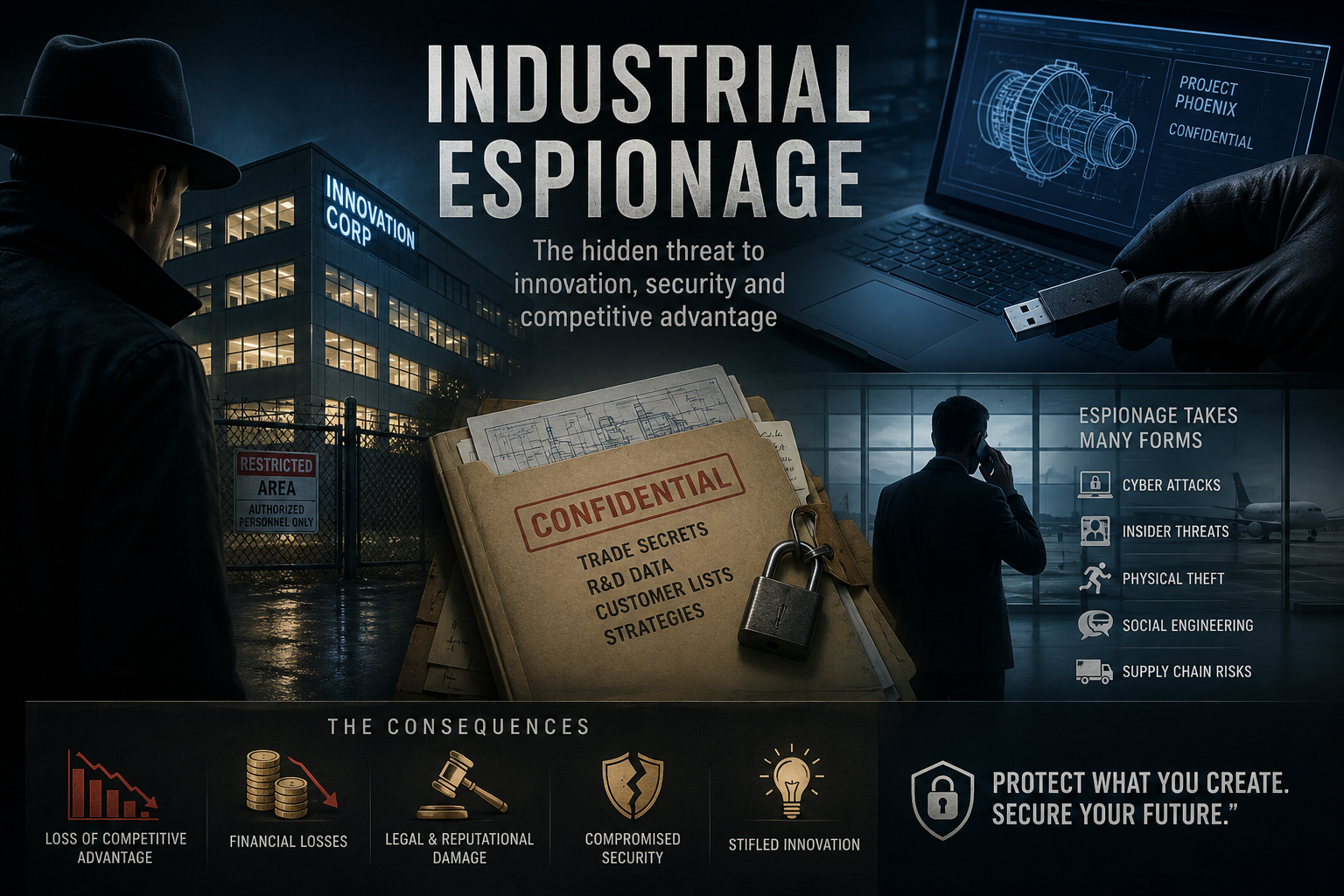

Protection Against Industrial Espionage and Data Theft
Industrial espionage has become so widespread and sophisticated that authorities and businesses often struggle to keep pace with the evolving threats. In many cases, the theft of intellectual property is only discovered when a product, technology, or business model has already been copied and introduced to the market by competitors. At that stage, it may be difficult or impossible to limit the damage or determine how the information was compromised.
For this reason, companies developing new products, technologies, or business models should consider establishing a dedicated data and IT environment for handling confidential projects. This environment should be completely separated from the company’s standard network infrastructure and have no direct access to the internet or external systems.
To strengthen security, the following measures should be considered:
- All workstations within the secure development environment should have Bluetooth, USB ports, SIM cards, and mobile data access disabled.
- An internal email system should be established without connectivity to external email services.
- Personnel working on sensitive projects should be provided with two separate IT workstations:

- An external workstation for general business activities and internet access.
- An internal workstation dedicated exclusively to confidential projects and development work.
- The server infrastructure may be divided into multiple security zones, for example:Two internal servers for confidential data and project information.
- Two servers for general business operations and administrative functions.
- Two servers dedicated to websites, web services, and external-facing applications.
If data must be transferred from the standard network environment to the isolated internal environment, this should only be done using a dedicated USB device. The device should be scanned for malware and security threats both before and after each transfer to minimize the risk of unauthorized access or malicious software infiltration.
In addition, companies should implement strict security procedures for meetings, facility tours, and visitor access. Guests and customers should not be permitted access to areas where confidential projects are being developed, and mobile phones, cameras, and other recording devices should be restricted or prohibited in highly sensitive areas.
All confidential projects, technical drawings, prototypes, business plans, research data, and development materials should be stored exclusively within the isolated internal environment to reduce the risk of industrial espionage, intellectual property theft, and unauthorized disclosure.
While an isolated network significantly enhances security, it does not provide complete protection. Effective security also requires robust access controls, employee awareness and training, encryption, continuous monitoring, and well-defined information security policies.